* = Amazon advertising link. As an Amazon Associate I earn from qualifying purchases.
A dirty toilet can make a clean desk look like the wrong place to start. On a routine cleaning round, though, the order needs to account for what each task could undo. Dust falls onto lower surfaces, emptying a bin can scatter dirt, and fetching supplies can leave footprints across a freshly mopped floor. Plan the round so later tasks protect the results of earlier ones.
Lean’s standardised work includes making the task sequence explicit so people can repeat a process and improve it. A cleaning round gives that idea a physical test: change the order and see which tasks you have to do twice.
Before starting, consider what each task could undo, what can run while you’re cleaning elsewhere and what you need to find out before committing to the round. Dusting, machine cycles and a walk-through each help answer a different part of that planning question.
The CDC’s cleaning guidance, written for healthcare settings, describes two directions: cleaner to dirtier, to avoid transferring contamination, and high to low, so dust and drips fall onto surfaces still waiting to be cleaned. Colour coding controls which equipment goes where, helping keep a toilet cloth out of the kitchen.
This example follows a three-hour office round. The site’s cleaning plan governs products, protective equipment and laundering, alongside the label instructions for surface compatibility, dilution and contact time. Never mix cleaning substances.
Inspect before you commit
Walk through with a rubbish bag and a clean, dry dusting cloth, checking what’s missing while there’s still time to fetch it. Collect ordinary loose rubbish, gather cups and plates separately, and remove accessible cobwebs and dust from high surfaces. The Green Sack refuse sacks* come from a UK-made range containing over 90% recycled plastic. Keep the dusting cloth separate from the fresh cloths reserved for wet cleaning.
Check soap, paper and other supplies during the walk-through, but respond immediately to hazards that can’t wait for their place in the round. Deal with spills promptly. An overflowing toilet also needs immediate attention, with access restricted and the right help obtained before you return to routine cleaning.
Green, then blue
Keep equipment assigned to its area. UK government guidance gives green for kitchens, blue for general areas and red for toilets and washrooms as an example. Schemes differ over sinks and basins, so follow the site’s chart and keep kitchen and washroom equipment separate even where their cloths share a colour.
Robert Scott recycled cloths* are made in the UK with colour-coded edges. Choose the colours specified by the site and replace cloths as they become soiled. Use these for wet cleaning, keeping the dry dusting cloth separate.
Start machine cycles early enough to run while you clean elsewhere. Load the dishwasher with Bio-D Dishwasher Tablets*, a vegan, phosphate-free option. If the round includes washing already-soiled cloths, start that cycle early too. Bio-D Fragrance Free Laundry Liquid* comes in refill sizes without added perfume. Keep dirty laundry apart from clean supplies.
After handling dirty dishes or laundry, wash your hands and take fresh kitchen equipment before wiping food surfaces and the kitchen sink. Bio-D All Purpose Sanitiser* is UK-made and refillable. Its maker specifies a 60-second wait before wiping with a clean damp cloth.
Move on to desks, tables, handles and other general surfaces with the blue equipment. Work downwards, using a fresh cloth assigned to that area, and leave the floor until the tasks above it are finished.
Red gets its own kit
Mark the washroom before starting. The Robert Scott door sign* spans doorways 70–95 cm wide, placing the warning at the entrance.
Polyco Nitri-Tech III gloves* are reusable nitrile gloves with published chemical-resistance guidance. Match that guidance to the products you’re using, then clearly mark the washroom pair and store it there. This model is blue, so colour alone won’t distinguish it from kitchen equipment.
Apply the toilet cleaner first so its waiting time overlaps with other tasks. Bio-D Fragrance Free Toilet Cleaner* is bleach-free and available in refills. Its maker’s routine-use instructions give five to ten minutes before scrubbing.
Use that interval to clean the basin, other surfaces and the outside of the toilet, moving from the least soiled areas towards the bowl with separate washroom cloths. Keep the surface cleaner out of the bowl. Once the specified time has passed, scrub beneath the rim and inside the bowl, then flush. Follow the urinal manufacturer’s instructions for its cleaning.
Keep each toilet’s brush and holder with that toilet. The ReBorn toilet brush* has a replaceable screw-in head, allowing you to replace a worn head while retaining the holder. NHS Somerset’s brush guidance describes rinsing the head beneath the water level while flushing, followed by thorough cleaning. Flush the bowl cleaner away before carrying out that rinse.
Rinsing alone doesn’t disinfect the brush. The person responsible for the cleaning plan needs to specify how to clean and disinfect the head and emptied holder, including the products, contact times and drying arrangements. ReBorn’s published FAQ covers disposal of an old head but doesn’t provide a complete routine cleaning method. Confirm that method before adding the brush to the kit, and store equipment clean and dry.
If a toilet is blocked, stop using it and mark it out of service. Don’t keep flushing when the water stays high or drains slowly. Report the fault and continue the routine elsewhere, attempting clearance only if you’re trained, equipped and authorised.
Empty bins, then restock
Empty ordinary bins towards the end of the round, when they’re less likely to fill again before you leave. Leaking or overflowing bins need earlier attention, while special waste follows its own procedure.
Clean any bin that needs it and fit a correctly sized liner. The Green Sack liners* use recycled plastic. Open the liner fully, seat it inside the bin and secure the top using the retaining ring or the liner’s intended fastening. Brabantia’s fitting video demonstrates a method for its StepUp bin, though the fitting will depend on the bin you’re using.
After handling toilets and waste, remove used gloves, wash your hands and switch to clean equipment before restocking. Unload the dishwasher once the cycle has finished and the items are cool and dry.
Ecoleaf toilet tissue* is made in the UK from recycled paper. Northwood Natural Z-fold towels H1NZN30NS* are UK-made from recycled paper, with 200 × 240 mm sheets. Check the fold and dimensions against the dispenser before choosing them.
Bio-D Fragrance Free Handwash* is UK-made, vegan and available in a 5-litre refill, without added perfume. Clean and refill dispensers according to their instructions, and pass shortages to whoever orders the supplies.
Finish the floors
With the tasks that could scatter dirt complete, vacuum carpets and suitable hard floors, including anything dropped while emptying bins. The compact Hetty HET160* is UK-made, with replaceable bags, filters and accessories. Numatic’s technical sheet gives a ready-to-work weight of 7.5 kg, which needs considering against the route along which you’ll carry it. Keep washroom floor equipment separate.
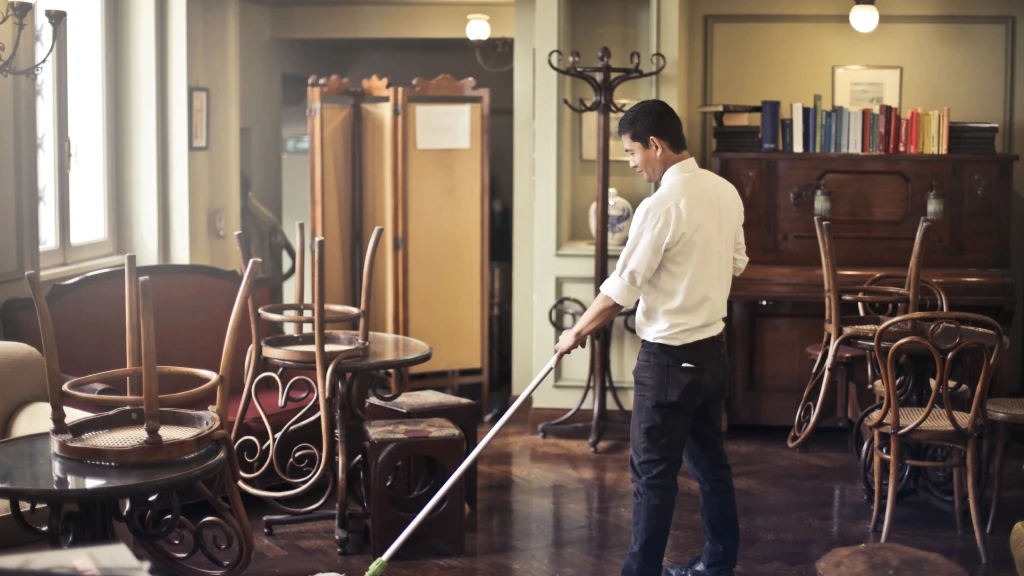
For smooth hard floors, the UK-made Robert Scott PY Exel mop head* uses recycled yarn. Its Exel aluminium handle* can remain in service when the head wears out. The Addis Eco bucket and wringer* uses recycled household plastic, is made in the UK and carries a manufacturer’s 10-year guarantee. Assign mops and buckets to their areas and change dirty water.
Bio-D Concentrated Floor Cleaner* is a refillable concentrate that needs diluting as directed. Before mopping towards the exit, put out the Draper wet-floor sign*, whose warnings face both directions. Keep people off wet sections or leave a dry route, removing the signs when the area is clean and dry.
Pause and check the next step
Stop each hour for water, rest and a check of what remains. Put down the equipment, wash your hands and drink away from cleaning products. Use the pause to check whether a new hazard has changed the order, whether a machine cycle is still running or whether you need to fetch supplies before finishing the floors.
At the end, clean and store the equipment, leave the floors safe and pass on shortages and faults. If the round ran late, record where the time went so the next round can address the particular task or interruption that caused it.